
AI Search
Are AI assistants recommending you — or your competitors?
Patients are asking ChatGPT, Perplexity, and Gemini where to get Botox, fillers, and laser treatments. We run the exact prompts they use and check if you're in the answer.
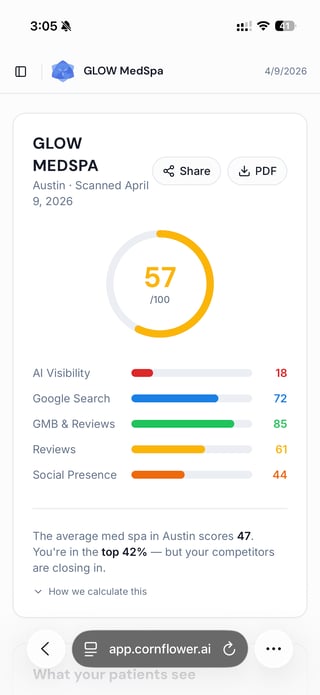
What we check
Three AI engines. Real patient prompts. Your name — or not.
We don't guess what patients ask. We run the actual prompts — "best med spa in [your city]," "where should I get lip filler near me," "top-rated Botox clinic in [your area]" — across all three major AI search engines.
ChatGPT
The most popular AI assistant. When patients ask for med spa recommendations, we capture ChatGPT's full response and check whether your business is named.
Perplexity
An AI search engine that cites its sources. We check if you appear in the recommendations and whether Perplexity links to your site.
Gemini
Google's AI assistant, increasingly integrated into Search. We capture its responses to the same patient prompts and check for your name.
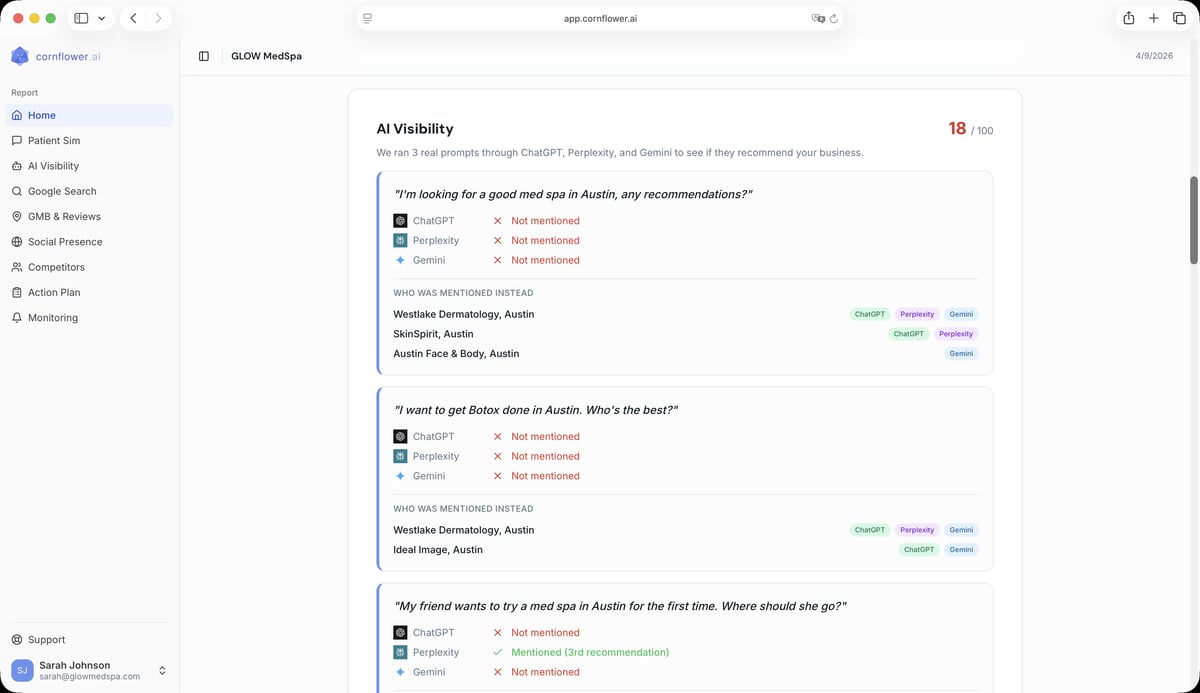
Prompt-by-prompt detail
You don't get a vague "AI score." You see each prompt we tested, each response, and whether you were mentioned — along with who was recommended instead.
The shift
AI is the new front desk.
Patients aren't just Googling anymore. A growing number start with AI — asking ChatGPT "where should I get Botox in Austin?" and trusting the answer. If you're not in that response, you've lost the patient before they ever visit Google.
Med spas that appear in AI search results are 3x more likely to show up in Google's local 3-pack. Visibility on one platform compounds across all of them. Yet most practices have never checked whether AI mentions them at all.
The most common result we see: a med spa with great reviews, a beautiful website, and zero AI visibility. A competitor with half the reviews gets recommended because they have the right signals in the right places.
How to improve
Getting into AI recommendations isn't magic. It's signals.
AI search engines pull from authoritative sources — directories, review sites, your own website, and structured data. Your Cornflower Report tells you exactly which signals are missing and how to add them.
Claim directory listings
Bing Places, Yelp, RealSelf, Healthgrades. AI engines pull from these sources. Being listed consistently gives you the signals they need to recommend you.
Publish treatment FAQs
AI engines love structured, authoritative content on your website. Treatment pages with clear Q&A give them the text they need to cite you.
Get mentioned on trusted sites
Press mentions, guest posts on health sites, and features on local "best of" lists all create the third-party signals AI uses to decide who to recommend.
Monitor weekly
AI results change fast. With Cornflower Monitoring, you'll know the moment a competitor enters — or you exit — an AI recommendation.
Explore